


The Sigma-MT Suite is available now for new VIP Cycle Analysts (founding members). Please contact me (on X or Substack chat) once you have joined or upgraded from standard membership to receive the software.
Prerequisites: the quick start, the spectrogram guide, detection guide, projection guide and the yield guide. You should be comfortable reading spectral power, trusting a score and understanding the bandpass as the dominant cycle extracted cleanly from price. No new keys are introduced in this part; the composite is configured entirely through the inputs.
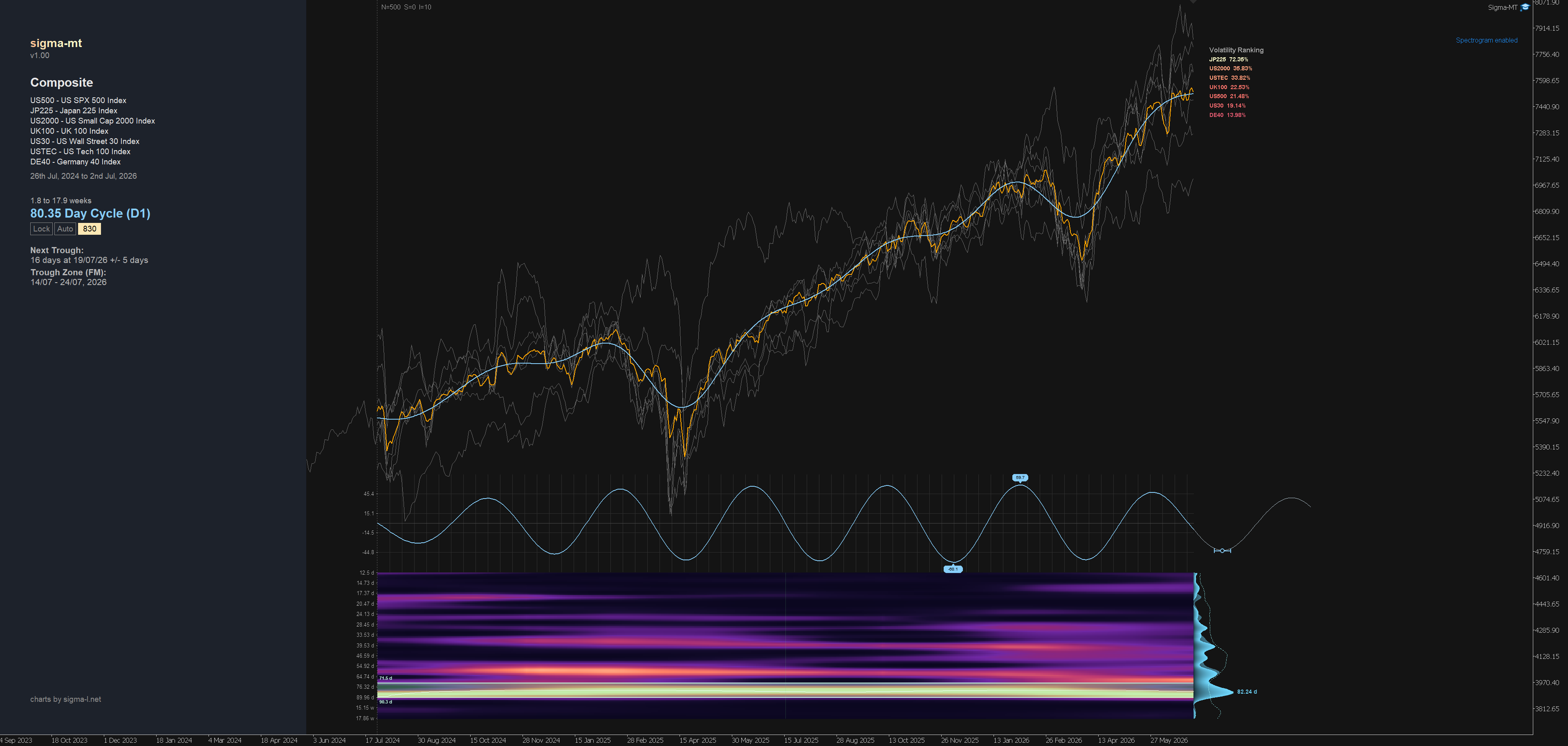
Introducing composite analysis
Every part of this course so far has interrogated one instrument at a time. This part widens the aperture, and in doing so it reaches back to one of the oldest ideas in the cycle literature. Hurst called it the Principle of Commonality: the observation that broadly related instruments do not each dance to a private tune but share their dominant cyclic behaviour, with the differences between them being largely a matter of amplitude and noise rather than of rhythm. A basket of dollar pairs breathes with the dollar. A group of index futures inhales and exhales risk together. Hurst asserted this from painstaking manual study in the 1960s; the composite mode in Sigma-MT lets you test it numerically on any basket you care to assemble, in seconds, and then, crucially, profit from the answer.
The logic of the feature is simple to state. Each member of a related basket carries the shared cycle buried under its own idiosyncratic noise: the news spike particular to one pair, the earnings gap particular to one stock. Combine the members correctly and the common rhythm, being roughly in phase across the basket, reinforces, while the private noise, being uncorrelated, tends toward cancellation. The signal-to-noise ratio of the commonality cycle rises above anything a single member could offer. Then, having detected that shared cycle with a confidence no lone chart could give you, the software answers the practical question that follows: on which instrument in the basket is trading optimal for yield over time?