The Sigma-MT Suite is available now for new VIP Cycle Analysts (founding members). Please contact me (on X or Substack chat) once you have joined or upgraded from standard membership to receive the software.
Prerequisites: the quick start, the spectrogram guide and the detection guide. You should be comfortable reading a spectrogram, trusting a score, and understanding that the bandpass is the dominant cycle extracted clean from the noise.
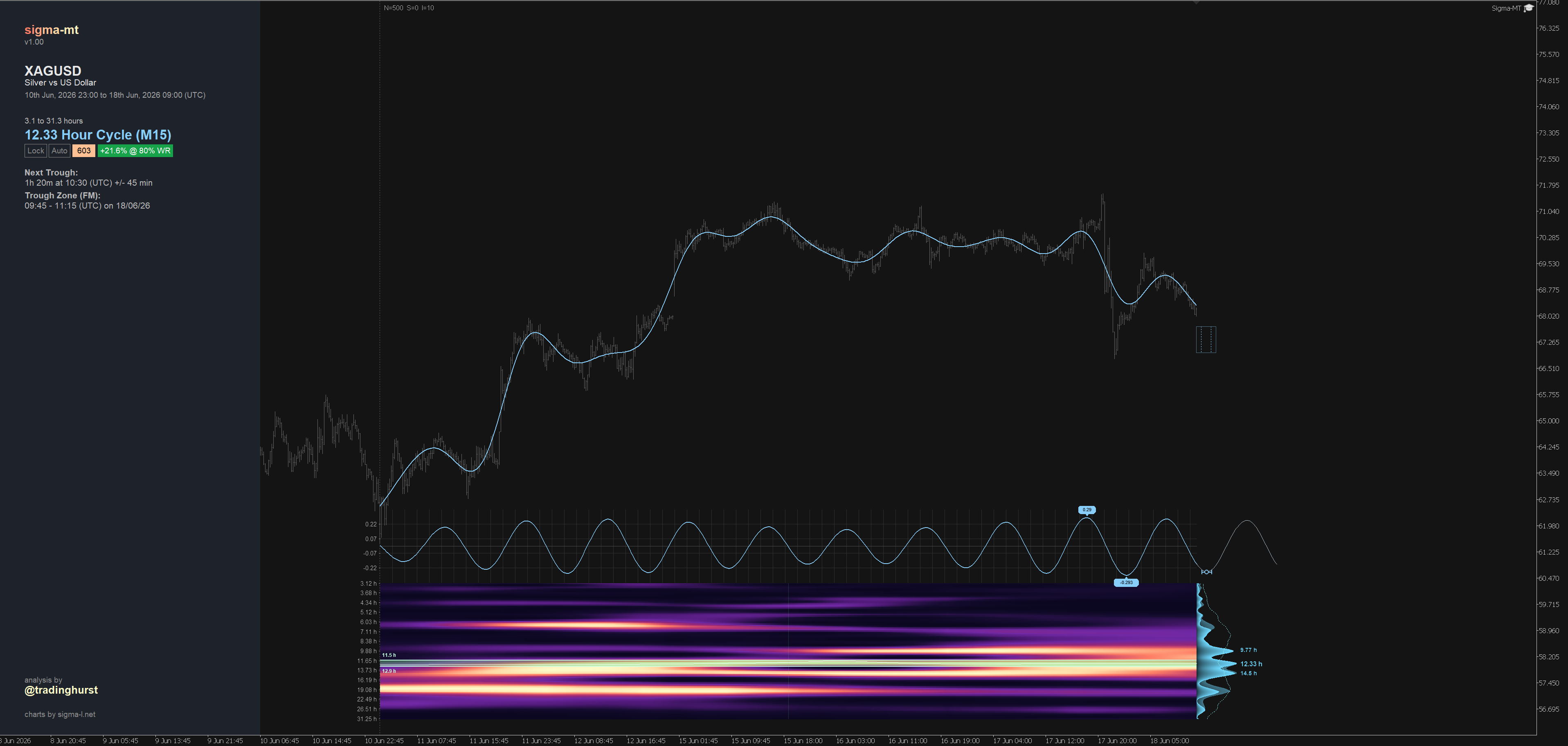
Detection told you a cycle is real and the score told you how stationary it is based upon extensive criteria. This guide concerns itself with what the engine does next: it takes that identified cycle and projects it forward, marks where the next turning point should fall, draws a window of uncertainty around it based upon characteristics of the periodic feature, and wraps the whole thing into a trade box you can actually act on. This is where the analysis stops describing the past and starts pointing at the future, so it is also where discipline matters most.
Carrying the cycle forward
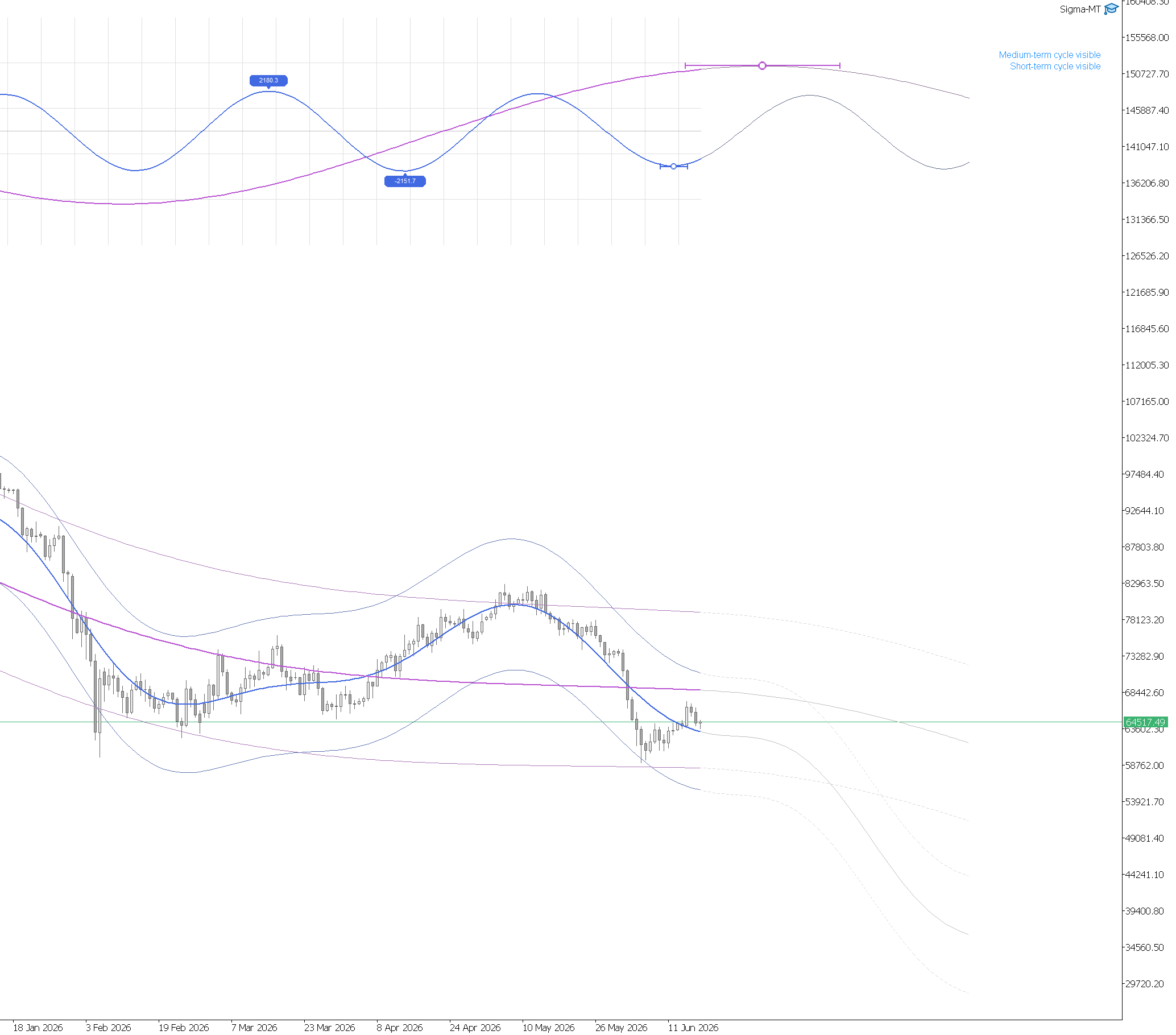
The simplest part of the projection is the extension of the bandpass itself. Once the dominant cycle is isolated, the engine continues its oscillation past the present bar, drawn as the dashed forward portion of the bandpass you have already seen. How far it runs is set by ForwardCycles in the inputs, expressed in lengths of the detected short-term cycle and clamped between 0.1 and 2.0, with a default of one full cycle. One cycle ahead is the default. Confidence in any extrapolation decays with distance from nowtime and a projection two cycles out should be read as a highly uncertain sketch of rhythm (especially at the right edge), rather than a forecast of price.
It is worth being precise about what is and is not being predicted here. The bandpass projection assumes the dominant rhythm continues at roughly its current wavelength and amplitude, which is a reasonable assumption for a high-scoring, stable cycle and a poor one for a low-scoring, modulating feature. This is the entire reason the score comes first in our guides as it is the first line of filtering for the analyst. The projection is only ever as good as the detection beneath it, and the engine will happily extend a weak cycle forward if you ask it to. Comprehending the score before trusting the projection is the habit that separates using the tools well from being misled by it.